.png)

Deck Repair & Restoration
Plenty of decks that get torn out didn't need to be. Plenty of decks that look fine are held on by nails pulling out of a rotten ledger. Telling those two apart is most of this job.
What we look at first
The ledger. It's the connection between your deck and your house, and it's where the serious failures start. We want to see how it's fastened, whether it's flashed, whether it's bearing on something it shouldn't be, and whether there's a lateral load connection at all.
The code requires a deck to be positively anchored to the building for both vertical and lateral loads, and specifically prohibits doing it with toenails or nails that work in withdrawal. On decks built before that was enforced, we find exactly that all the time. We also find ledgers bolted through stucco with no flashing, and ledgers bearing on stone veneer, which the code doesn't allow.
The lateral connection is the one that fails without warning. It's a tension tie between the deck framing and the house framing, and when it's missing the deck can separate under load even though every board looks fine.
The flashing detail that changed, and why it matters on a repair
The 2025 code cycle added a prescriptive requirement for ledger flashing. The water-resistive barrier has to run continuous behind the ledger and lap over the vertical leg of the flashing. On an older house with no water-resistive barrier behind the siding, that means installing a new strip of one behind the ledger, running above the top of it.
Which means a deck replacement done under the current code gets a detail that essentially no older deck has. If your deck is coming off anyway, this is the moment that detail is free.
What we can usually save
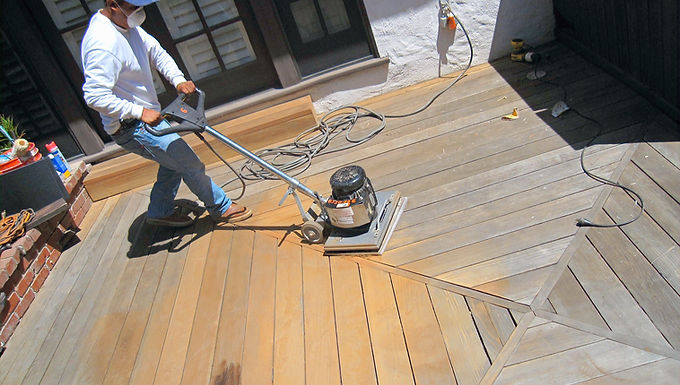
Framing is often fine when the surface isn't. Hardwood decks in particular go gray and rough long before they go structurally bad, and a sand and re-oil brings them back for a fraction of a replacement. More on Ipe and hardwood decking.
We replace individual boards, sister or replace damaged joists, re-flash ledgers, add lateral connections, rebuild stairs, and swap failed railings without touching the deck field. Where posts have rotted at the base we replace them and set them properly. The code wants either an approved connector or twelve inches of embedment for lateral restraint, and a post sitting on a paver has neither.
What isn't worth saving
If the framing is undersized for current load requirements, if the ledger has been leaking long enough to get into the rim joist and the wall behind it, or if the deck is over living space and the waterproofing has failed, you're usually better off rebuilding. We'll tell you that plainly rather than selling you a repair that buys eighteen months.
Old redwood decks with heavy checking, decks built without permits to no particular standard, and decks where every fastener is corroded through. Those are the common ones.
Refinishing
For hardwood: sand, clean, and oil, or let it go silver. Both are fine. Oil is a maintenance commitment, not a one-time fix.
For composite and PVC: these don't refinish. They clean. If a composite deck is chalking or the cap has worn through, that's a replacement conversation, not a restoration one.
Getting an honest answer
We're a deck company, not a demolition company. If a repair will do the job we'll say so. We've been doing this in Los Angeles since 1995 and the referrals are worth more to us than the difference.
Call (818) 345-2866.