.png)

Rebuilding in the Palisades or Altadena? The code relief does not cover your deck
If you're rebuilding after the Palisades or Eaton fire, somebody has probably told you the project can be built to the 2022 building code rather than the 2025 one that took effect in January. True, and it saves real money.
It doesn't apply to your deck.
The Governor's order that allows the older code, Executive Order N-29-25, carves out one category, and LADBS quotes it word for word in its own guidance: projects may use the 2022 California Building Standards Code "with exception of the fire and public life safety requirements presented by the State Fire Marshal." Los Angeles County says the same thing in Title 26. A 2025 rebuild may use the 2022 code as long as it meets the 2025 fire safety requirements.
Fire is the one thing the waiver doesn't get you out of. And a deck in a fire hazard severity zone is almost entirely a fire question.
Like-for-like isn't a code exemption either
The second thing that gets misunderstood, and this one costs people time at plan check.
Like-for-like rebuild rules, the ones that let you rebuild the same house without fighting current zoning, up to 110% of the old footprint in the City and 10% or 200 square feet in unincorporated County, are planning relief. They aren't building code relief. Los Angeles County states it plainly: like-for-like rebuilds "do not need current Zoning Code compliance" but "must comply with current Building, Fire, and Health and Safety Codes."
So if the house that burned had a redwood deck off the back, you aren't entitled to rebuild a redwood deck. You're entitled to rebuild a deck in the same place at the same size, out of materials that meet the current wildfire rules.
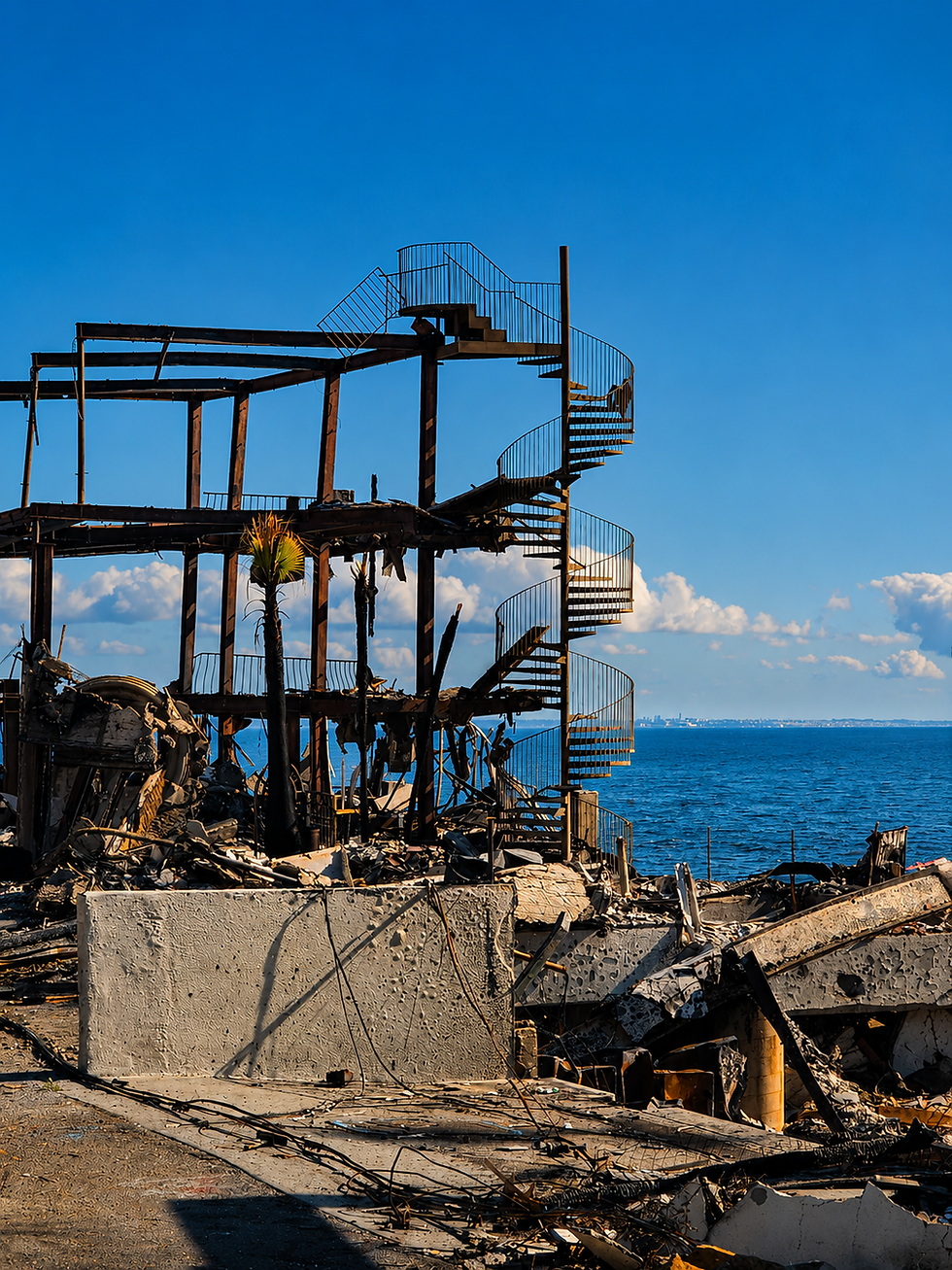
What the current rules actually require
In January 2026 California moved its wildfire construction requirements into a new standalone code, the California Wildland-Urban Interface Code, Title 24 Part 7. Chapter 7A came out of the building code, Section R337 was repealed from the residential code, and both landed in Chapter 5 of the new one.
That renaming matters more than it sounds. Almost everything written about fire rebuilds, including some agency pages that haven't caught up, still says "Chapter 7A." Guidance citing 7A isn't necessarily wrong about the substance, but it's quoting a code book that no longer exists. Appendix H of the new code has a cross-reference table mapping the old section numbers to the new ones.
For a deck, the operative section is now CWUIC 504.7.3.2. LADBS has a plan-check checklist for exactly this, form PC/STR/Corr.Lst.116, the Fire Hazard Severity Zone Supplemental Checklist, effective January 1, 2026. Section G covers underfloor enclosures, decks and projections. Download it and hand it to whoever is drawing your plans: the LADBS Fire Hazard Severity Zone checklist (PDF)
Three things in it catch most people out.
The walking surface has to come from a defined list. Deck boards and stair treads must be noncombustible, or ignition-resistant, or pass a specific test, most commonly SFM Standard 12-7A-4. Picking something that looks solid isn't the standard. It's a listed-product question. Which products carry those listings, and how to check one yourself in about two minutes, is covered here: which decking is approved in a California fire zone
Deck-to-wall intersections need flashing. A minimum of six inches of metal flashing, applied vertically on the exterior of the wall, at every deck-to-wall intersection. It costs almost nothing during construction and it's expensive to add later.
The underside has to be enclosed. Underfloor areas have to be enclosed to grade with compliant exterior walls, and exposed underfloor and projections have to be noncombustible, ignition-resistant, fire-retardant-treated wood, or one-hour rated construction. On a hillside lot in the Palisades, where the deck is often the only flat ground on the property, this is the single largest line item nobody budgeted for. More on how hillside lots change a deck build: hillside and elevated decks

Altadena is not the City of Los Angeles
If your property is in Altadena, your permits don't go through LADBS. Altadena is unincorporated Los Angeles County, which means Public Works Building & Safety and Regional Planning, working out of the Altadena One-Stop Permit Center on West Woodbury Road: the LA County one-stop permit centers
That's not just a different counter. The County hasn't adopted the new wildfire code wholesale. County Title 26 amends Chapter 5 of it selectively rather than adopting Part 7 in full, so an Altadena deck has to be checked against County Title 26 and not only against the state code text. A spec that passes in the Palisades isn't automatically a spec that passes in Altadena.
Jurisdiction follows the parcel, not the fire name. The Palisades Fire also burned unincorporated County land in the Santa Monica Mountains, served by the Calabasas One-Stop, and part of the City of Malibu, which permits on its own. The Eaton Fire also reached Pasadena and Sierra Madre, both of which are their own cities. If you aren't certain which agency your lot answers to, find out before anyone draws anything.
The dates to put on your calendar
Two deadlines are converging, and neither one is well advertised.
Los Angeles County's like-for-like rebuild track requires applications within two years of the emergency declaration. The emergency was declared in early January 2025, which puts that window closing in early 2027. Confirm the exact date with Regional Planning, but if you're in unincorporated County and haven't applied, this is the one to move on: the County like-for-like rebuild track
Separately, most policies' additional living expenses coverage has a statutory floor of 24 months from the date of loss, which for a January 2025 loss also runs out in early 2027. California law allows up to 12 more months where the delay is outside your control, and the statute names permit delays and contractor unavailability as qualifying reasons. You generally have to ask for it rather than receive it automatically. Replacement cost runs on a longer clock, a minimum of 36 months from the first actual-cash-value payment, with six-month extensions available for good cause.
One more thing is coming but isn't here yet. In August 2026 the Board of Forestry approved the Zone 0 regulations, the rules about combustible material within five feet of a structure. As of this writing they're still going through the Office of Administrative Law with no effective date set. New construction will have to comply once they take effect, and existing structures phase in over several years. Anyone selling you Zone 0 compliance today is selling you something that isn't law yet. It's worth designing for if you're building now, because a deck built tight to the house is exactly what those rules address.

An honest word about where the rebuild stands
Permits issued isn't the same as homes finished. As of mid-August 2026 the Palisades had passed a thousand homes under construction, with thirty-five primary residences holding certificates of occupancy. Altadena was at roughly 97 homes rebuilt and about 1,785 under construction, against some 3,510 applications. In both areas a large share of households still haven't applied at all, and the reporting keeps pointing to insurance and financing as the bottleneck rather than permitting.
If you're somewhere in that middle, you're not behind.
What we do
We build decks, and only decks and the structures that go with them. On a fire-zone rebuild that means checking the specific product against the State Fire Marshal's listing before it goes on a material schedule rather than after plan check flags it, detailing the flashing and the underfloor enclosure properly the first time, and telling you when something you've been quoted won't pass.
We work directly for homeowners and as a deck subcontractor for general contractors and architects handling the rest of the rebuild. What we do on fire-zone work: fire-zone decking
Sources, and where to check things yourself
The Governor's order that allows the 2022 code with the fire carve-out: Executive Order N-29-25 (PDF)
For City of Los Angeles rebuilds: LADBS Executive Order 1 implementation guidelines (PDF)
City of Los Angeles rebuild information: the City recovery site
Los Angeles County rebuild information: the County recovery site
On claim deadlines in a declared emergency: the Department of Insurance 2026 notice (PDF)
Statewide progress numbers: the State of California rebuilding dashboard
Incident pages: CAL FIRE on the Palisades Fire and CAL FIRE on the Eaton Fire
Danny Deck Construction, building in Los Angeles since 1995. CA License #896848. Call (818) 345-2866.
Written August 2026. Fire-zone code and rebuild programs are both changing quickly right now. Verify anything time-sensitive with your permitting agency before you rely on it.